Ala Rengîn, the flag of the Kurdish people
The Kurdistan flag: Ala Rengîn
The Kurdistan flag is a horizontal tricolour of red, white and green with a golden sun of exactly 21 rays at its centre. Kurds call the flag Ala Rengîn, the colorful flag, and the sun Roj. It is the flag of the Kurdish people, official in the Kurdistan Region since the flag law of 11 November 1999, and its day is 17 December.
Looking for the red, white and green flag with a sun? This is it.
Plate I
The flag at a glance
The essentials, each with its degree of certainty. Full references at the end of this page and in the source register.
| Name | Flag of Kurdistan; in Kurdish: Ala Rengîn (the colorful flag) | documented |
|---|---|---|
| Design | Horizontal tricolour red, white, green with a centred golden sun of 21 equal rays | documented |
| The sun | Roj, the Kurdish word for sun and day; 21 rays, one pointing straight up | documented |
| Proportions | Height to length 2:3; the sun including rays spans half the height | documented |
| First arranged | Around 1920 in Constantinople, in the circle of the Society for the Advancement of Kurdistan | probable |
| Standardized | 1998 to 1999; flag law passed by the Kurdistan National Assembly on 11 November 1999 | documented |
| Flag Day | 17 December, designated by Parliament Decision No. 48 (2009), commemorating Mahabad | documented |
Plate II
What the colors of the flag mean interpretation
The meanings people give the flag are consistent across communities and publications. Strictly speaking they are interpretations: the formal specification defines geometry and colors, not symbolism. Here they are, with their status marked honestly.
Red
The blood of the martyrs and the long struggle for freedom and dignity.
White
Peace and equality, the wish to live in harmony.
Green
The mountains and landscapes of Kurdistan, nature and hope.
Gold
The sun as the source of life and the light of the people.
Read together, the flag tells one story: a people that paid in blood, wants to live in peace on its own land and turns toward the light. That is why the flag is a national symbol for all Kurds regardless of faith, and why it is distinct from every party flag: partisan recolouring of the national flag is criticized within Kurdistan itself.
These readings appear in cultural and semi-official publications. The construction documents of the flag do not define color symbolism; that is why they carry the label interpretation, not documented fact.
Plate III
The sun Roj and its 21 rays
The sun is what makes the flag unmistakable. It is called Roj, the Kurdish word for sun and day. It has exactly 21 rays, equal in size and shape, drawn as one continuous star whose rays touch at the base, and one ray points straight up.
What the 21 rays stand for is tied above all to Newroz. The Kurdistan Region Presidency states that the 21 rays represent the Kurdish new year, which begins on 21 March: the turn of the year, the moment light returns after the dark.
Newroz, the official reading
The Kurdistan Region Presidency states that the 21 rays represent Newroz, the Kurdish new year that begins on 21 March.
Rebirth, the designer’s reading
Mehrdad Izady, who standardized the flag in 1998 to 1999, chose 21 as a sacred number of rebirth in the native Yazdani religious traditions: the rebirth of the nation. His reading and the official one point the same way.
The alphabet, a folk reading
A circulating explanation says the rays stand for 21 letters of the Kurdish alphabet. The standard Latin alphabet for Kurmancî has 31 letters; this reading is unsupported.
In the specification of 1998 to 1999 the sun sits at the exact centre of the flag. Including its rays it spans half the flag’s height; the disc alone spans a quarter. During standardization the Flag Institute suggested a smaller sun with fewer rays; the designers kept 21 rays reaching into the red and green bands. The sun shown here is the official Roj emblem, not a redrawn approximation.
The sun page: the three readings, the full geometry and the common errors
Plate IV
The history of the flag in five milestones
This is the history as the sources actually support it, which makes it slightly different from the version most websites repeat. Where the record is thin, the label says so.
- Around 1920
Constantinople: the design is born
probableThe design was first arranged around 1920 in Constantinople, in the circle of the Society for the Advancement of Kurdistan. The earliest primary document known is a letter of 21 January 1928 from Memduh Selîm to Îhsan Nûrî Paşa, uncovered by historian Sadat Ulugana, which contains a drawing of the flag. The popular story that the flag was presented at the Paris Peace Conference of 1919 to 1920 is supported by no archival evidence.
- 1927 to 1930
Xoybûn and Ararat: the first national flag
documentedXoybûn, founded on 5 October 1927 in Bhamdoun, adopted the tricolour with the sun as the Kurdish national flag. It flew during the Ararat rebellion, and in August 1930 contemporary newspapers documented it as the flag of the movement.
- 1945 to 1946
Mahabad: the flag over a republic
documentedThe Republic of Kurdistan was proclaimed at Mahabad on 22 January 1946 by Qazî Mihemed on Çarçira Square, while Ey Reqîb was sung. Its flag carried a different emblem from today’s, a sun flanked by ears of wheat and a pen; the national flag kept the plain sun. The dominant account says the flag was first officially raised there on 17 December 1945, the date Flag Day commemorates. In a video testimony, Fatima Assad Shahin recounts how, at fourteen, she sewed that flag at the request of Mustafa Barzani.
- 1998 to 1999
Standardization and the flag law
documentedIn 1998 and 1999 the historian Mehrdad Izady, with Bijhan Eliasi and collaborators and in consultation with the Flag Institute, fixed the modern specification: 21 equal rays, the sun over half the flag’s height, defined colors. The Kurdistan National Assembly passed the flag law on 11 November 1999.
- Since 2006
The flag in public life
documentedIn September 2006 the flag replaced the previous state flag on public buildings across the Kurdistan Region. In 2012 the Kurdistan Region team hosted and won the VIVA World Cup in Hewlêr under it. Every Newroz it is waved en masse in Amed and at diaspora gatherings; Cologne hosts the largest Newroz in Europe. In Bakur and Rojhilat, displaying the flag has led to prosecutions and remains an act of courage.
Plate V
Official status and Flag Day, 17 December
Within the Kurdistan Region the flag is official: the Kurdistan National Assembly passed the flag law on 11 November 1999, commonly cited as Law No. 14 of 1999. Across the four parts of Kurdistan its status differs: the flag law applies in Başûr, while in Bakur and Rojhilat people have been prosecuted for displaying the flag.
Kurdistan Flag Day is 17 December, designated by Parliament Decision No. 48, which most sources date to 2009, commemorating Mahabad. Schools and institutions hold flag ceremonies and giant flags are unrolled, including one of 1,300 metres in Silêmanî and one of 132 metres in Helebce honouring Qazî Mihemed. Kurds in Rojava and the diaspora mark the day online and at gatherings.
Flag Day: its origin, the two accounts of the date and the celebrations
Plate VI
Exact colors and construction
Two color sets are documented, and few pages explain the difference. The 1998 to 1999 specification gives Pantone values. The web, following the Wikimedia reference file, settled on slightly different values that most sites copy without knowing their origin. Use one set consistently across the whole flag: Pantone for print, the web values for screens.
| Color | Pantone (specification) | Hex (specification) | Hex (web) | RGB (web) |
|---|---|---|---|---|
| Red | 032C | #F32837 | #ED2024 | 237, 32, 36 |
| White | · | #FFFFFF | #FFFFFF | 255, 255, 255 |
| Green | 355C | #009A3D | #278E43 | 39, 142, 67 |
| Golden yellow | 116C | #FFCC00 | #FEBD11 | 254, 189, 17 |
Construction values
| Ratio (height to length) | 2 : 3 |
|---|---|
| Bands | Three equal horizontal bands: red above, white, green below |
| Sun diameter including rays | 1/2 of the flag height, at the exact centre |
| Sun disc without rays | 1/4 of the flag height |
| Rays | 21, equal in size and shape, straight sides, sharp points, touching at the base |
| Orientation | One ray points straight up; the vertical meridian passes through its topmost point |
The designer chose the shades deliberately: they were based primarily on the regulation colors of the Hungarian and Italian flags, and avoided the colors of the states that govern parts of Kurdistan. No official CMYK specification exists; the CMYK values on the colors page are derived and labeled as such.
Plate VII
Displaying the flag correctly
Most mistakes with this flag concern the sun. Because 21 is odd, a rotated sun is the most common reproduction error; even the Wikimedia reference file needed a geometry correction in 2020. Four checks:
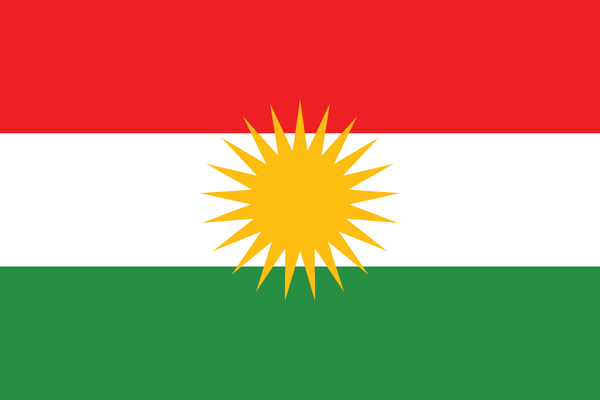
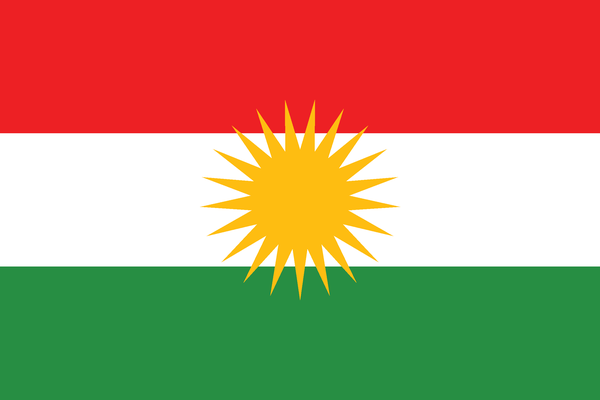
- ✓One ray points straight up, on the vertical line through the centre, and red is the top band.
- ✗A rotated sun, or a generic sun with 16 or 24 rays, is not the flag.
- ✗A sun smaller than half the flag’s height, a darkened red or a grass green change the flag.
- ✗Party colors on the national flag, and the Presidency emblem with four longer rays, are not the flag either: the national flag is distinct from party flags and from emblems.
Plate VIII
Free, accurate files
Every file on this site is generated from one verified source: the public domain sun path of the Wikimedia reference file, checked to have exactly 21 rays and placed at the specified half-height diameter. SVG, PNG in every size, transparent versions, wallpapers, social formats and a print PDF, in both documented color sets, all released into the public domain (CC0). No attribution required.
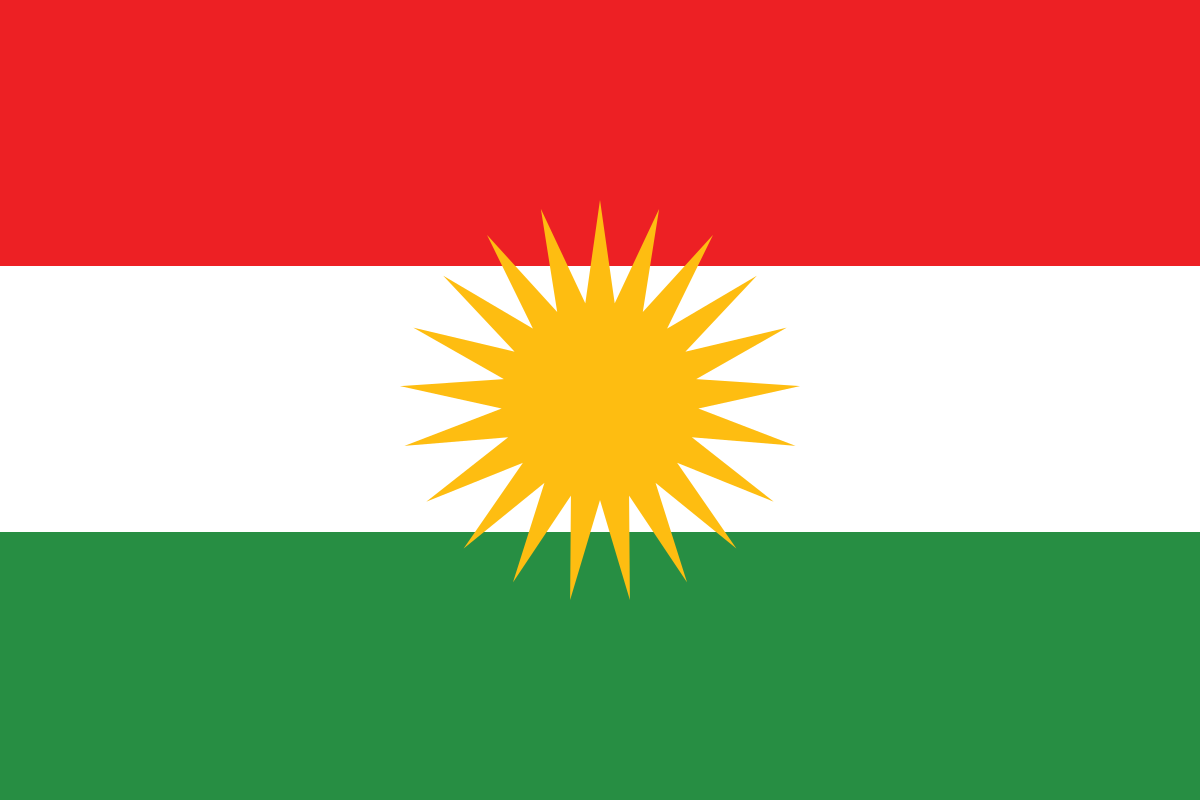
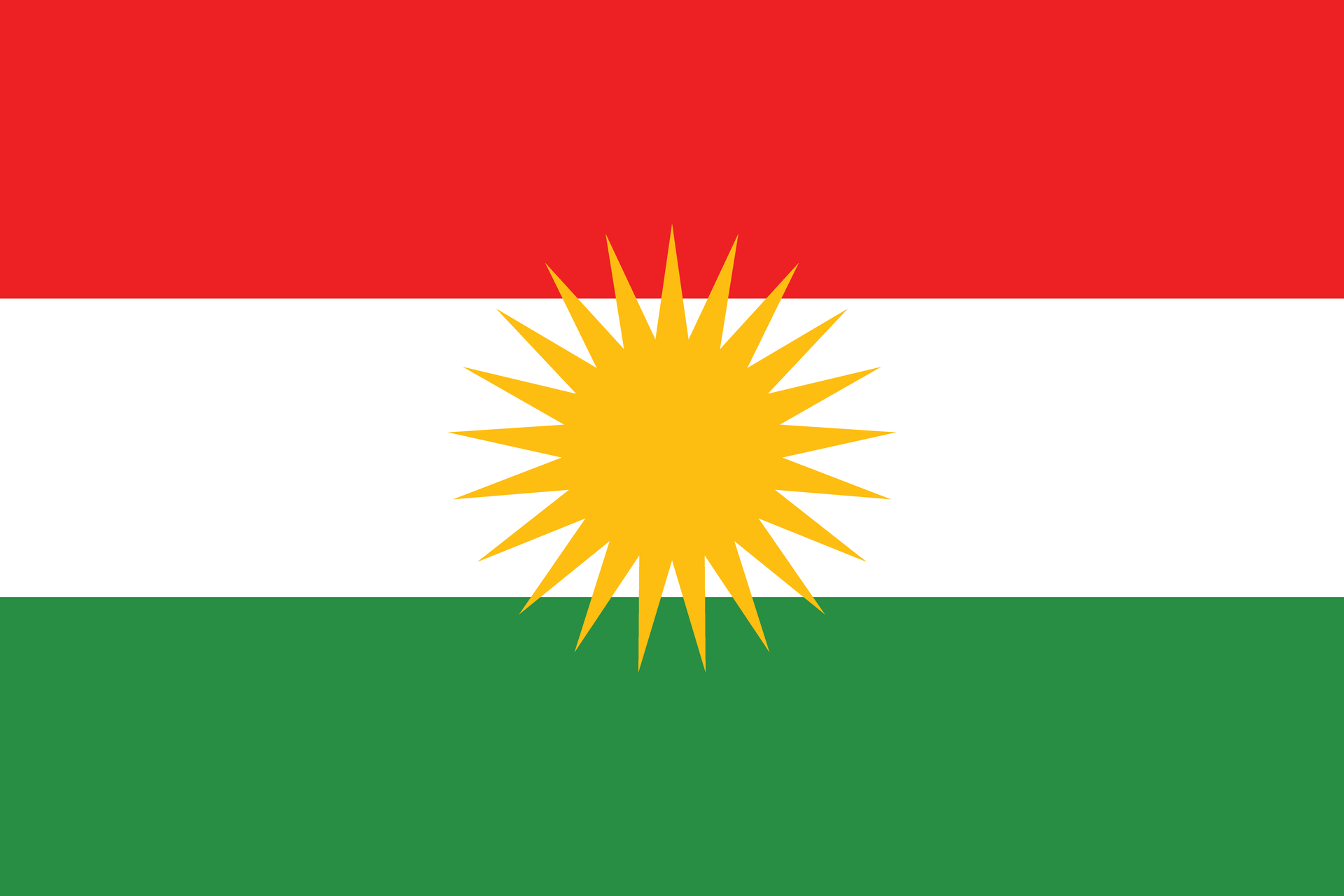
Plate IX
Is there a Kurdistan flag emoji?
No. Country flag emoji are generated automatically from ISO 3166-1 country codes, and in 2022 the Unicode Consortium stopped accepting flag emoji proposals of any category. The ISO 3166-2 code the Kurdistan Region received in 2022 makes a flag technically valid as a so-called tag sequence, but no platform renders it yet. Until that changes, the community writes the flag itself: a red heart, a sun and a green heart.
Plate X
Questions people ask
What flag is red, white and green with a sun?
The flag of Kurdistan, Ala Rengîn. The reliable check is the sun: exactly 21 pointed rays, one pointing straight up.
Why does the sun have 21 rays?
The official reading ties 21 to Newroz, the Kurdish new year on 21 March; the designer tied 21 to rebirth in native Kurdish religious traditions. The alphabet reading is unproven.
What do the colors mean?
Red is read as the blood of the martyrs, white as peace and equality, green as the land of Kurdistan, gold as the source of life. These are documented interpretations; the specification defines no symbolism.
Is the Kurdistan flag official?
Within the Kurdistan Region, yes, by the flag law of 11 November 1999. 17 December is the official Flag Day.
What are the exact colors?
Specification: red PMS 032C, yellow PMS 116C, green PMS 355C. Web: red #ED2024, green #278E43, gold #FEBD11, white #FFFFFF.
Plate XI
Sources, certainty and corrections
Every important claim on this page carries a source and a degree of certainty: documented, probable, interpretation, oral tradition or unproven. The list below gives the sources behind this page; the full register and the claim list are public. Found an error? The corrections page explains how to report it and what happens next.
Sources for this page
- ARK News Rojava
- Kurdistan Marks Flag Day · Channel8
- File:Flag_of_Kurdistan.svg bestandsgeschiedenis
- File:Roj_emblem.svg
- CONIFA Kurdistan FA
- Mahabad Republic · FOTW
- FOTW Kurdistan
- FOTW party flags
- Kurdistan Digest May 2026 · Washington Kurdish Institute
- 964media Flag Day · 2024
- Ala Kurdistanê (Flag of Kurdistan) · Kovara Bîr · 2021
- Xoybûn · Wikipedia
- Republic of Mahabad · Wikipedia
- 2012 VIVA World Cup · Wikipedia
- Hurriyet Daily News · 2012
- The National Flag of Kurdistan · Institut kurde de Paris · 1998
- Kurdish Globe Flag Day
- Kurdistan24 Amed Newroz · 2017
- Kurdistan Flag Day: A symbol of identity, resistance, hope · Kurdistan24 · 2024
- Kurdistan Flag Day · Kurdistan24 · 2024
- The Unfinished Dream: Remembering The Republic of Kurdistan in Mahabad, 80 Years On · Kurdistan24 · 2026
- Kurdistan24 Cologne 2025
- Flag of Kurdistan · KURDISTANICA · archive
- 'I didn't know the flag I made for the Kurds would be so important' · Kurdistan Memory Programme
- The History of the Kurdistan Flag · KurdShop
- Flags, Colours and our National Identity · Medium · 2015
- Sadat Ulugana on the history of the Kurdish flag · Medya News
- Emblem of the KRP · presidency.gov.krd · 2019
- Presidency over Vlagdag · 2023
- Rudaw-interview Izady · 2017 · archive
- Rudaw Cologne Newroz · 2025
- Rudaw Newroz 2023
- THE NATIONAL FLAG OF KURDS & KURDISTAN · saradistribution.com · 1999 · archive
- A banner of identity takes center stage across Kurdistan · Shafaq News · 2024
- Stockholm Center for Freedom on Newroz prosecutions of minors (2022) · Stockholm Center for Freedom · 2022
- Learn About the Kurdistan Flag · The Kurdish Project


Last reviewed: 2026-10-15